S. Kenneth Smith

Come walk a while.

Through stories of faith, spirituality, and mystery, we can explore the journeys that help us see life differently.

A note before you start

Hello, friend. I'm glad you found your way here.

Most of us know what it feels like to walk a long road with a heavy heart. Two travelers once did that, on the road out of Jerusalem to a little town called Emmaus. They were sad. They were confused. And a stranger fell into step beside them. They didn't know it yet, but it was Jesus.

That's what my books are about. God walks with us, even when we can't see Him. Even when we have questions. Even when we've wandered far. I hope something you read here gives you a little rest for the journey.

— Kenneth

The books

Stories of faith, hope, and the journeys that shape us.

Cover of Walk to Emmaus by S. Kenneth Smith S. KENNETH SMITH Walk to Emmaus

Walk to Emmaus

Faith Over Fear series

Tim is a teenager in a small Southern town. He goes to church, but he has lots of doubts. Ophelia, the family's housekeeper, walks close with God, and Tim wants what she has. When a stranger named Tuskegee comes to town to learn the truth about an old massacre of the Lower Creek people, Tim joins the search. What he finds changes his life forever.

Cover of The Return by S. Kenneth Smith S. KENNETH SMITH The Return

The Return

A novel

After twenty-seven years away from the Catholic Church, Richard McAllister begins an unexpected journey back to the faith he left behind. The Return follows both walks—the one that carried him away and the one that slowly draws him home—as ordinary moments, remembered prayers, unexpected encounters, and gentle spiritual guidance begin pointing him toward a purpose he never expected. Along the way, Richard discovers that some prayers are never forgotten—and some callings never fade.

Cover of One Hour to Inner Peace by S. Kenneth Smith S. KENNETH SMITH One Hour to Inner Peace

One Hour to Inner Peace

A quiet hour with God

Life gets loud. Worry piles up. This short book invites you to set aside one hour, breathe, and let God quiet your heart. It's simple, gentle, and made for anyone who feels tired inside.

Cover of Why I'm Catholic by S. Kenneth Smith S. KENNETH SMITH Why I'm Catholic

Why I'm Catholic

An honest, friendly look at the faith

Each of us needs to find our place in God's kingdom. Oftentimes, that journey takes us down several paths before we finally reach “home.”

Why I’m Catholic is the story of my own journey—where I began, the paths my faith took me down, and the questions and experiences that eventually led me to the Catholic Church. It is not an argument that everyone must follow the same path. It is simply the story of how, after a lifetime of seeking and believing, I found the place where I knew I belonged.

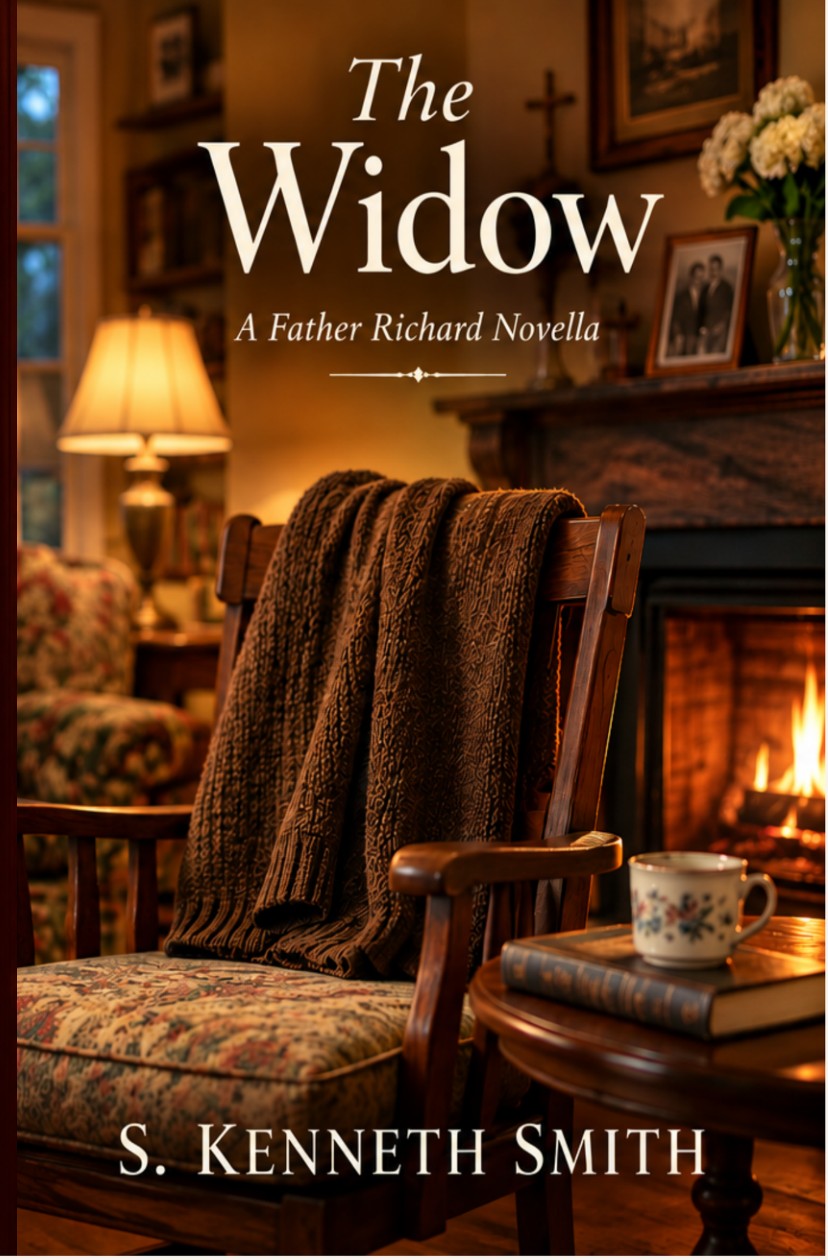
Cover of The Widow by S. Kenneth Smith

The Widow

A Father Richard Novella

When Elizabeth Harrington loses Tom, the love of her life, she faces a future she never imagined. As grief threatens to overwhelm her, Father Richard offers the steady presence of a friend and priest. Through shared memories, gentle conversations, and faith, Elizabeth begins to discover that even in deep sorrow, God remains close.

Along the Way

Giving Thanks by Giving

Every November, we set aside a day to give thanks. We gather around tables, enjoy the company of family and friends, and reflect on the blessings we have received. We give thanks for our homes, our health, our families, and the many things that make our lives comfortable.

And we should.

But I wonder if Thanksgiving sometimes becomes more about counting our blessings than considering what those blessings allow us to do.

We often measure how blessed we are by what we possess. Yet some of our greatest blessings cannot be measured in dollars or counted among our possessions. They are found in our ability to make a difference in someone else’s life.

We have the ability to encourage someone who is discouraged, comfort someone who is grieving, or simply listen to someone who needs to be heard. We can offer kindness to a stranger, patience to someone who tests ours, or forgiveness to someone who has hurt us.

None of these things requires great wealth. They simply require a willingness to give something of ourselves.

I sometimes wonder how different our world might be if, instead of asking only what we have to be thankful for, we also asked what someone else might have to be thankful for because of us.

Did we make someone’s day a little brighter? Did we offer a word of encouragement when it was needed? Did we help someone carry a burden that had become too heavy to bear alone?

Perhaps the greatest expression of gratitude is not found in what we say around the Thanksgiving table, but in what we do when we leave it.

After all, the blessings God gives us were never intended to stop with us. They are meant to be shared.

This Thanksgiving, may we be thankful not only for what we have received, but also for the opportunities we have been given to make a difference in the lives of others.

And perhaps, when we gather again next Thanksgiving, we will have even more reasons to be grateful—not because we have accumulated more, but because we have given more of ourselves.

Faith Over Fear. Always.

Actions Speak Louder Than Words

We’ve all heard the familiar expression, “Actions speak louder than words.”

It’s a simple statement, but one that carries a great deal of truth, particularly when we consider our lives as Christians.

We can talk a good talk. We can proclaim from the mountaintops, and to anyone willing to listen, that we are Christians. We can attend church regularly, quote Scripture, and speak passionately about our faith.

But what do our actions say?

In the Letter of James, we are reminded that faith without works is dead (James 2:17). It is a powerful statement because it challenges us to look beyond what we say we believe and examine how those beliefs influence the way we live.

Jesus gave us two great commandments: to love God with all our heart, soul, and mind, and to love our neighbor as ourselves.

Notice that He didn’t tell us simply to talk about love. He commanded us to love.

And love, if it is genuine, requires action.

Are we feeding the hungry? Clothing those who have little? Offering shelter to those without a home? Speaking up for the marginalized, the forgotten, and those whose voices are seldom heard?

Or are we content to acknowledge their suffering while continuing with our own comfortable lives?

In Matthew 25, Jesus speaks of feeding the hungry, welcoming the stranger, clothing the naked, and visiting the sick and imprisoned. He reminds us that what we do for the least among us, we do for Him.

That’s a remarkable thought.

When we encounter someone in need, we are presented with an opportunity not merely to demonstrate kindness, but to encounter Christ in another human being.

Of course, none of us can solve every problem or meet every need. We have our own responsibilities, limitations, and struggles. But perhaps the question isn’t whether we can change the entire world.

Perhaps the question is whether we can make a difference in the small part of the world God has placed before us.

A meal shared. A kind word offered. A lonely person visited. A stranger treated with dignity. A voice raised on behalf of someone who cannot easily speak for themselves.

These may seem like small things, but they are expressions of something much greater.

Our faith should not be something we put on Sunday morning and take off when we leave church. It should be reflected in how we treat others throughout the week, especially those who can offer us nothing in return.

Perhaps we should spend a little less time telling the world that we are Christians and a little more time showing the world what Christianity looks like.

After all, if our actions do not reflect the love of Christ, what are our words really worth?

The Whole Person: Mind, Body, and Spirit

Life has a way of keeping us busy.

There are responsibilities to fulfill, people who depend on us, things that need fixing, and countless little tasks that seem to demand our attention. We move from one obligation to the next, sometimes feeling quite accomplished at the end of the day.

But somewhere in all that busyness, we may overlook something important: ourselves.

We are more than the work we do or the responsibilities we carry. Each of us is a whole person—mind, body, and spirit. And each part of who we are deserves attention.

We care for our bodies through rest, nourishment, and movement. We care for our minds by learning, thinking, reading, and sometimes simply allowing ourselves a moment of peace. And we care for our spirits through prayer, reflection, gratitude, or quiet moments when we consider the deeper meaning of our lives.

Yet how often do we give one of these our attention while neglecting the others?

In the Gospel of Luke, Martha becomes occupied with the responsibilities of hospitality while Mary sits and listens to Jesus. Martha’s work is important, but Jesus gently reminds her that there is something equally important she has overlooked.

Perhaps there is a lesson for us in that familiar story.

Being busy is not necessarily the same as living fully. And taking time to care for ourselves is not selfish. It is part of appreciating the life we have been given.

One way of making room for ourselves is through meditation. In my book One Hour to Inner Peace, I suggest an approach that divides an hour into smaller sections, each intended to help us slow down, reflect, and give attention to our spiritual lives and our relationship with God.

But an hour is not a requirement, nor is the method a formula everyone must follow. Meditation, like so many worthwhile things, takes practice. For someone just beginning, even five, ten, or fifteen minutes may be enough. As we become more comfortable with quiet reflection, we can gradually extend that time.

After all, five meaningful minutes are better than an hour we never begin.

Maybe we don’t need to add another task to tomorrow’s schedule. Maybe we simply need to make a little room in it.

Room to rest. Room to think. Room to pray. Room to be.

After all, in taking care of everything and everyone else, shouldn’t we remember to take care of ourselves, too?

Essentials and Nonessentials

The older I get, the more I realize that there are essentials and nonessentials within Christianity.

We may worship differently. We may have different traditions, different practices, and even different understandings of our faith. Those differences matter, and they are worth exploring. But I have come to believe they are not the most important thing.

The essential is whom we worship.

For Christians, that is Christ.

Perhaps we would understand one another a little better if we remembered that more often. We don’t have to agree on every nonessential to recognize what—or rather, Whom—we share.

And maybe that’s a good place to begin.

Author S. Kenneth Smith

About Me

I’ve spent most of my life around words—first as an educator and now as a writer. Even in retirement, I still find myself in the classroom, because apparently after all those years I haven’t quite figured out how to stay away.

My own journey has included a lifelong interest in faith, spirituality, and the questions that arise when we wonder about things we cannot always explain. Over the years, that journey has taken me through several Christian traditions and, eventually, home to the Catholic Church. Those experiences find their way into much of what I write—stories about faith, doubt, loss, grace, mystery, and the possibility that there may be more to our lives than what we can readily see or understand.

I write both fiction and personal reflections, but my hope for each is much the same: that something in these pages might encourage someone else along the way. And if a good conversation happens over a cup of coffee, all the better.

Learn about the faith

New to Christianity? Curious about the Catholic Church? You don't need to have it all figured out. Here's a simple place to begin.

What Christians believe

  • God made you and loves you. You are not an accident.
  • Jesus is God's Son. He became a man, lived among us, and showed us what God is like.
  • He died and rose again. Jesus gave His life on the cross for our sins, and on the third day He rose from the dead.
  • We can be made new. Through Jesus, we are forgiven and invited into God's family forever.

“For God so loved the world, as to give his only begotten Son; that whosoever believeth in him, may not perish, but may have life everlasting.” — John 3:16

What makes Catholics Catholic

  • One Church since the apostles. Catholics believe Jesus built His Church on Peter and the apostles, and it has been handed down ever since.
  • The sacraments. Seven holy signs, like Baptism and Confession, where God pours out His grace.
  • The Mass and the Eucharist. At every Mass, Catholics believe Jesus is truly present in the bread and wine.
  • Mary and the saints. A big family in heaven who pray for us, the way a friend would.

“Thou art Peter; and upon this rock I will build my church.” — Matthew 16:18

Ready to take a first step?

Write to Me

Did something you read here—or in one of my books—stay with you?

I'd like to hear from you. Whether you'd like to share a thought, ask a question, or simply say hello, feel free to send a message.

I read every message myself. Please allow a few days for a reply.